
You might be thinking, I will go on blah blah blah.. of what’s in your mouth… We know all things, this is so much basic…. tell me something new., But have you asked anytime some of these questions to yourself..?
- How many teeth I have?
- How is my tissues, strong or weak?
- Apart from teeth, what else I have in my mouth?
- Any of my teeth have decay?
- Are all of my teeth strong enough.?
- The liquid in mouth. What is it called?
- Are there living bacteria in mouth?
- What does our mouth do?
Below you might get these answers & try to check ur mouth.. or visit dentist to know more about it….
Oral cavity refers to mouth… The oral cavity includes the lips, hard palate (the bony front portion of the roof of the mouth), soft palate (the muscular back portion of the roof of the mouth), retromolar trigone (the area behind the wisdom teeth), front two-thirds of the tongue, gingiva (gums), buccal mucosa (the inner lining of the lips and cheeks), floor of the mouth under the tongue and the teeth.
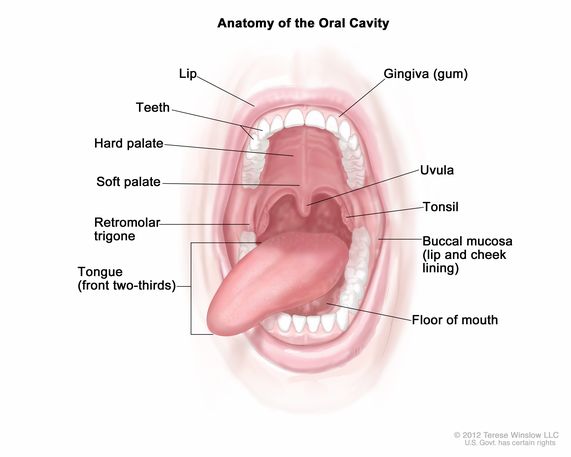
Mouth anatomy
The main structures of the mouth include:
Lips – The two mobile and muscular structures that form the entrance to the mouth. The lips mark the transition from skin to moist mucous membrane.
The vestibule – The space between the soft tissue (lips and cheeks), and the teeth and gums. The vestibule is kept moist by secretions from the parotid salivary glands, which are located in front of the ears and behind the angle of the jaw.
Mouth cavity – The mouth cavity is bounded by several structures. The alveolar arches (bony structures that contain the teeth) surround the mouth cavity at the front and on the sides – overhead are the hard and soft palates and below is the tongue. The mouth cavity is kept moist by secretions from the submaxillary and sublingual salivary glands located in the floor of the mouth beneath the tongue.
Gums – Are made up of the fibrous and dense tissue that lines the alveolar arches and hugs the teeth. Gums are pink in colour & are firm, which means heathy. If they turn reddish then inflammed.
Teeth – A person has two sets of teeth over the course of a lifetime. The average child has their full set of 20 primary (or milk or baby) teeth by the age of three years. The primary teeth start to fall out between the ages of about six and seven years, and are gradually replaced by permanent (or secondary or adult) teeth. By about 21 years, the average person has 32 permanent teeth – 16 in the upper jaw and 16 in the bottom jaw.
Palate – Consists of the hard and soft palates. The hard palate is the bony roof of the mouth. The soft palate is a fold of membrane that hangs between the mouth cavity and the back of the throat. The little dangling bit you can see when you stick out your tongue and say ‘ah’ is called the uvula.
Tongue – The tongue is made up almost entirely of muscle fibres. It is divided into an oral portion (tip, blade, front, centre and back) and a pharyngeal (throat) section. The tongue helps us to taste, speak and swallow.
Minor salivary glands – Make the clear fluid (saliva) that keeps the mouth moist and contains enzymes to break down food. These glands are found in various locations around the mouth, including the inner cheeks.
Nerve supply – The face’s trigeminal nerve provides sensation (feeling) and helps us to bite, chew and swallow. It has three main branches, including:
Upper branch – services the scalp and forehead.
Middle branch – services the cheeks, top lip, upper jaw, top teeth and gums, some areas of the nose.
Lower branch – services the bottom lip, bottom jaw, bottom teeth and gums.
What does healthy mouth anatomy look and feel like?
In a healthy mouth, the tissues are pink, firm and moist. If you have a healthy mouth, your breath will smell pleasant or neutral.
Healthy gums are firm and pink, not red or white. They are not swollen or sore. Teeth should be firmly planted in the gums, not wiggly. It should not hurt to chew or brush your teeth.
A healthy mouth will not have any bumps, flaps, gaps or rough patches.
Mouth is a home to about 700 species of microbes. These include germs like bacteria, fungus, and more. “Everybody has these microbes in their mouth,” says Dr. Robert Palmer, an NIH expert on oral microbes. Some microbes are helpful. Others can cause problems like tooth decay and gum disease. Troubles begin when microbes form a sticky, colorless film called plaque on your teeth.
Now it’s time to check your oral cavity & see how many teeth you have, how are they working, are they in proper condition, how are other tissues surrounding it. In my experience, there was a patient who had 36 teeth in his mouth and who didn’t knew about it till the age of 30!!! When he noticed tooth pain and consulted me..then it was come to his notice of extra extra teeth which probably are not useful only…
Conclusion –
What does our mouth do? Our mouth and teeth let us make different facial expressions, form words, eat, drink, and begin the process of digestion. The mouth is essential for speech. With the lips and tongue, teeth help form words by controlling airflow out of the mouth.
In the next upcoming blogs, you will get the answer for many more questions. Till then stay tuned , support & comment on bigfitmouth.
 The Dental House Hubli
Leave a comment